
And in the end...
That which remains of us after we depart.

Warning: this post discusses death and cremation. Reader discretion advised.
When I was in Nepal last November, I ventured one late afternoon down to the Pashupatinath Temple on the banks of the Bagmati river that flows through Kathmandu. Actually, referring to it as merely “a” temple is somewhat like referring to Indonesia as merely “a” country: the UNESCO World Heritage site, among the oldest and most significant of all religious complexes in all of South Asia, with records of its existence dating back 1600 years, houses over 500 shrines across its several hundred hectares, and many “Sadhus” live their ascetic lives amongst them.
Pashupatinath is especially well known for its public cremation sites on the riverbank itself, where it’s quite normal for visitors to observe proceedings. Doing so myself that afternoon felt both pertinent and poignant, given that the year had started with my mother’s death and her own cremation.
I was on hand – literally, holding her hand, alongside my brother who was doing the same - for my mother’s earthly demise. But the cremation itself took place in private, per our western/Christian traditions, without the presence of anyone but the professionals involved.1 Later, our mother’s ashes were delivered to the funeral home where they were to remain until such time as Nic, who lives in Sweden, and myself, domiciled in the USA, could attend to her written request for their dispersal.
I had yet to be in the direct vicinity of those ashes when, that November afternoon at Pashupatinath, I watched a young girl, accompanied by a somewhat older male that I took to be a relative, walk ritualistically around the deceased body of a woman whose own age I could not determine, despite her face being open to the heavens. Was it the girl’s own mother, taken too young? A grandmother? Either way, it was evident that the young girl had been designated the day’s senior duty when, after a series of circumambulations, she was handed a flaming torch with which she gradually set fire to the corpse.
All around, other cremations were in their own stage of process, and all would follow the same path: the body would be slowly consumed by flames (perfumed bricks atop of the chest keeping the air free from stench), the family would eventually depart, and when the corpse had burned fully, the pyre would be tipped down, and the ashes swept into the Bagmati river. Where those ashen remains cho(o)se to settle is neither here nor there - though very much here and there.
Footage of the particular cremation I witnessed is above; it is your choice whether to press play. For my own part, I had expected, in advance, to find the experience of watching a deceased human body burn like this to be unsettling. But that proved not to be the case. Open to the world – including the elements - as these cremations are, it came across as both sacred and secular. Ritualistic and perhaps hopeful (I do not know enough of Hinduism to comment further on that last word), yet accepting of the earthly facts that we all return to dust.
Fast forward eight months. This past, most recent weekend, having finally coordinated our schedules so that we could be in the UK at the same time, my brother Nic and I met in London, and traveled together to the East Devon south-coastal village of Branscombe, where our mother, Ruth Macdonald (Campbell) Fletcher to give her full (plus maiden) name, then a London-based school teacher and single mum, had bought a small caravan back in the 1970s.
It was an impulse purchase at the end of a family trip to see older relatives, and it was among the best decisions she ever made.
The initial caravan site, looking out over the cliffs towards the English channel from a field on a farm some 300 feet above the Branscombe beach, provided mum with a calm respite from the daily stress of working in tough South London schools, as did the simplicity of the life we all enjoyed there. So idyllic was it for mum that she made a point of driving us – and our two cats - down from London pretty much every school holiday, from Easter through to the October half-term. As a result, I spent much of my childhood in Branscombe or thereabouts.


Our small caravan was eventually moved back one field, presumably upon the orders of the National Trust, to avoid being conspicuous to the various walkers and hikers out on the cliff path. Then it was swapped out for a mobile home that was itself gradually equipped with running water, electricity and even – I believe - flushing toilets as the field it was housed within filled with similarly middling-class mobile homes.
But even as we lost our solitude and acquired some mod cons, our time in Branscombe continued to feel calming. I loved it down there, as did our cats, who foraged at night for mice, voles and shrews that they would typically then bring inside the home to chase and torture while we tried to sleep, and one of which – the one aptly named Pirate - additionally pillaged neighboring sites for their morning bacon.
Talking of breakfast, I was soon entrusted to set off on a morning walk with some money in hand, from which I quickly found short-cut paths from our field down through the woods to the village deep below and, at an age that modern western parents now won’t let their kids out of their sight, I purchased the morning supplies. Initially that meant the morning bread from the last stick-fired bakery in England - for the morning bread, and the post office for a newspaper.
Early in my walking exploits, I saw that a different farm at the bottom of the hill advertised eggs for sale, so I knocked on their door, and soon became friends with the family there, who’d bring me inside for a morning cup of tea and send me off with lettuce and tomatoes and such like in addition. They were called the Gibbons, and our families became firm friends, just as the two remaining Collier brothers at the bakery would greet me gleefully at the start of my every holiday arrival with a simple “It’s the boy!” in the heaviest of south-western country accents you could imagine. (One of them never left the village; the other only traveled to deliver bread by van to the immediate vicinity.)


Given that none of us wanted to spend the whole six-week summer holiday in Devon, mum took to letting out the “caravan” (as we still liked to call it) when she wasn’t there, gradually creating an annual roster of trusted renters who would leave the place as they found it and who covered her steadily increasing costs. The only time she ever had a complaint from a renter about the condition that it had been left in was after she was… let’s be kind and use the word “unsmart” enough to rent it out to me and three of my mates, one of whom is still my band-mate, another of whom I got to see also on this latest trip “home.”
Us four young men, all in our early twenties, spent the week doing what young men like us did back in the mid-80s: we drank a lot (I struggle with scrumpy to this day, as a result), we chatted up local girls, we drove the narrow lanes at high speeds tempting death, and we made enough of a nuisance in ourselves in the local town of Sidmouth to attract the attention of the police (who, in fairness, had very little else to be concerned with). We also managed to turn a two-hour rowing boat hire into something close to a search-and-rescue operation. Leaving the mobile home as spotless as we found it was not only the last thing on our minds; it was something we were truly incapable of doing.
I may have gone back to Branscombe after that, but if so, I don’t have recollections. As such, other than that madcap holiday with my mates, the place doesn’t form part of my adult memory. The same with my brother: Nic and I each figured we hadn’t been to the area in a solid 40 years before our return this last weekend.
It was good then to have been allocated a reason to return.
And so, on Saturday morning, after I had jogged over the cliffs from our Air BnB in the neighbouring, eastern village of Beer (yes, that’s the correct spelling) to participate in the Park Run on its own eastern neighbouring town of Seaton’s beachfront, my brother and I drove to and parked at the beach at Branscombe. From there, with our mother’s remains inside a bag inside a formal box, inside a better-than-plastic carrier bag, we set off westerly up the cliffside, along the Coastal Path, towards what we still call the “caravan site.”
Our mother had asked, in writing, for her ashes “to be scattered over the cliffs at Berry Barton,” the name of the farm that owned the caravan and mobile home sites. We didn’t really understand if she meant over the cliff edges, or just over and along the cliffsides and even the farmland itself. And though it would have been technically inaccurate last Saturday to say she was no longer on hand to ask – she was very much in hand – clearly we were not going to get a reply. As it turned out, once we reached the peaks of our ascent, and opened up the contents of the formal box within the bag, and then the formal bag within the formal box, it turned out there was plenty enough of her for all options.2
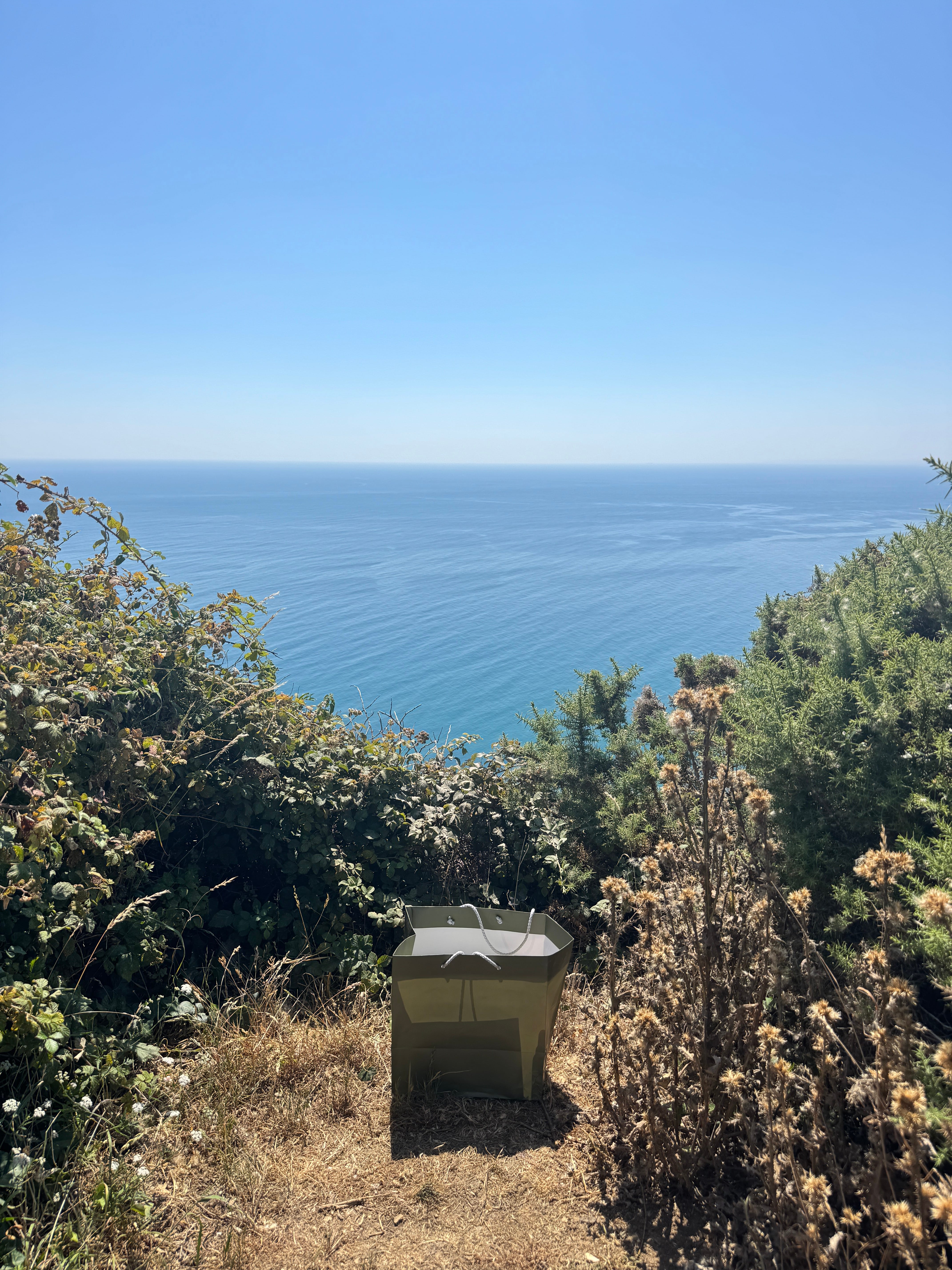
The initial sight of mum’s ashes brought a wave of emotion and a brief cry, though I had expected it to be more powerful and prolonged. Perhaps the manner in which she had passed eighteen months earlier, engaging unconsciously in a steady expiry of breathing like the slowing down of an old-fashioned clock – and the fact that we had been there to accompany and witness those final breaths – have allowed for a peace that would not be present under more trying circumstances. Maybe my visit to Pashupatinath helped; the passage of time also. And maybe, given my own successful ageing into the Senior Railcard bracket, I could stare at the ashes of the woman who brought me into this world in the sober knowledge that one day this will be all that remains of myself also.
I put my open hand in the bag, clenched it full of ash, brought that clenched fist to the cliff edge, unfurled it, and spread the contents as close to the ground, and as close to the cliff edge, as possible. Sure enough, and as we’d jokingly predicted, the stiff breeze from the sea blew much of the ashes straight back towards us.
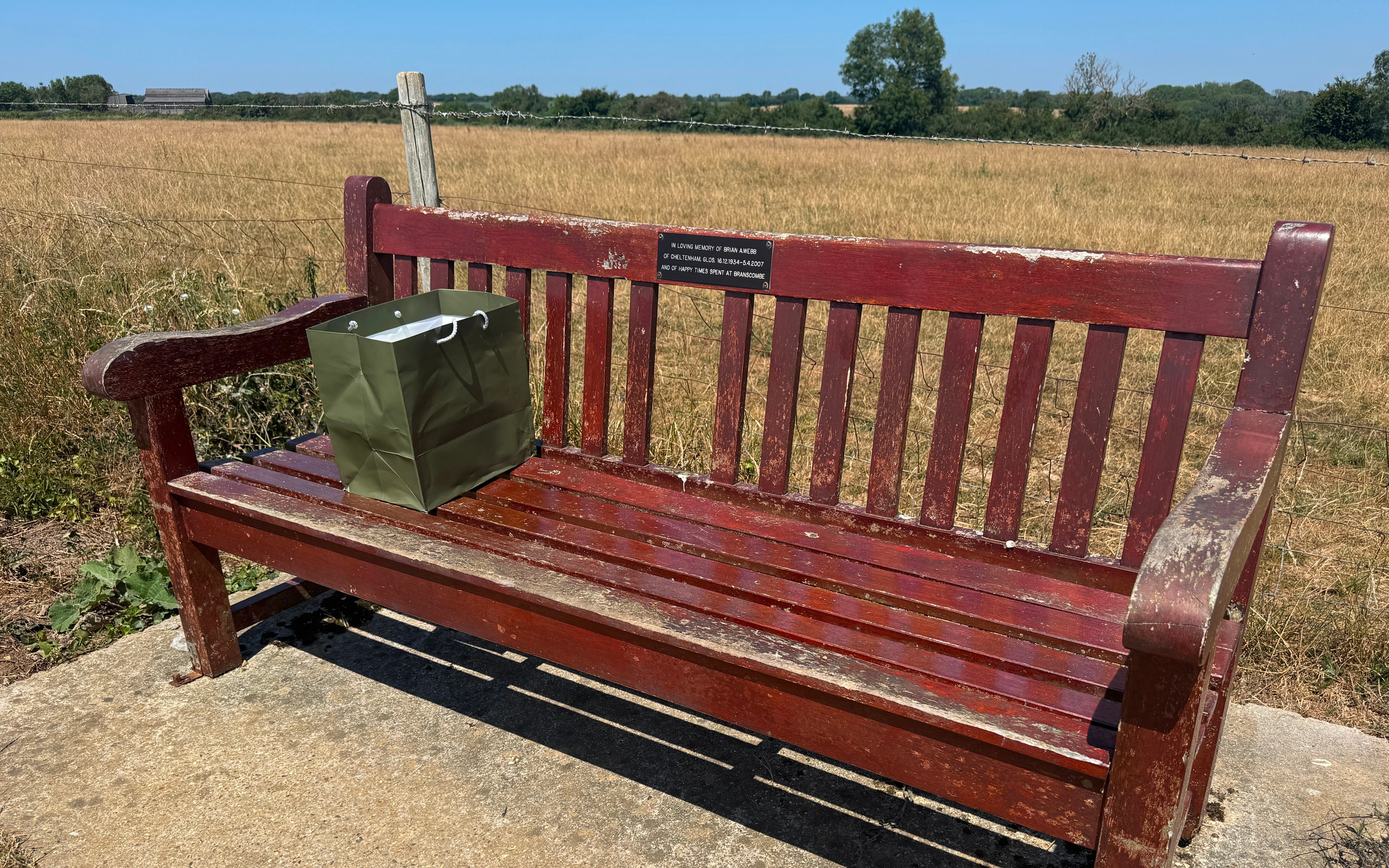
We did likewise at a couple more stops, one of them by a commemorative bench installed in memory of a man born in the same year as our mum, which was way back in 1934. (See above.) He had hailed from Gloucester, but as with Shetland-born Ruth, the southern English coastline had exerted a pull upon him. Indeed on a beautiful if ominously hot summer Saturday in July, this part of the English coastline is as wondrous as almost any sight in the world. This was evidenced, with perfect timing, by the arrival from the west of a pair of cheerful middle-aged German males in sporty hiking regalia who asked if we would take a photo of them.
As I did with almost everyone I met on my trek in Nepal, I turned that request into a full-blown chat. They were on the seventh stage – and their seventh annual visit – of however many stages comprise the South West Coast Path, all 1014 kilometers of it, and they seemed as happy as crabs left alone in a rock pool below to be making the pilgrimage. Indeed, it was confirmation of this happiness that neither seemed to know how many further annual week-long stages they had ahead of them in the years to come. It was enough to know they’d be able to get a beer in Seaton and a seat at a pub table to watch that night’s World Cup Quarter-Final.
I was not the one to take their picture, my hand now being grey with ash. It became greyer still with every occasion I dipped it into the bag and scattered a little more of our mother’s ashes along and/or over the cliff edge. I was, however, willing to dust up my own camera, and I took photos as we went, later observing that I was treating mum to a grand tour of her former favourite haunts, even if the pictures themselves look a little like her remains are one of those garden gnomes “borrowed” for a world tour of famous landmarks.
Regardless, at a certain point where we felt we’d reached a particularly lovely viewpoint, not far from the old caravan site itself, I passed the bag to my brother, who did not dip his hand in but preferred to pour the bag from without, allowing much of the ashen contents to fall free into the wind. I was standing upwards of that wind. Mum promptly blew back into my face and even, and despite my wearing glasses, into my eyes. I laughed. As I told my brother, I can see the metaphors and allusions in anything and everything. Draw your own conclusions.
The bag still felt somewhat heavy as we turned inland, where we noticed that in the field where our initial modest caravan had been situated, indeed in the very north-western corner that it had occupied, the farm – still in the same family’s hands, indeed the current farmer is most likely the former farmer’s son who once provided my brother with unpasteurized milk in the mornings straight from the dairy cattle that no longer seem to be part of the family concern - had built a storage shed. We headed towards it, and from there looked out at the same view that had greeted us those first school holiday mornings before bureaucracy forced us to retreat to the field behind: green fields topped by blue ocean topped again by – at least today – a bright blue sky.


From that corner, I could picture the young me who, unaware that he had been born to run, would nonetheless jog around the field – relentlessly – for fun. I could picture that same little boy wandering off in the mornings with some of mum’s money and an empty carrier bag, returning an hour or more later with the fresh eggs – once or twice scrambled by the fact that I’d been banging the bag around on my back in an over-enthusiastic imitation of Dick Whittington - and the fresh bread and the paper and whatever else. I could also picture mum sitting out front on a deck chair as the sun went down, probably with a cocktail in hand. And I could sense her presence all around me and all within me, as I have done every day since her physical death.
Together, Nic and I emptied the bag, scattering the last of mum’s remains right there, exactly where the caravan had first stood. From there, she can help fertilise this corner of a field in the corner of England that she loved so much. She couldn’t have asked for more. And she wouldn’t have expected less. She always knew we would take care of her.
Moving on through and into the larger field where our caravan had been subsequently relocated and upgraded, I noted that there were still water pumps dotted around the field. I found the one closest to the specific pitch that our mobile home had occupied for so many years, turned the tap, and washed the last of my mother’s remains from my hand. Her ashes melded into the water, just as they do at the Bagmati river at Pashupatinath Temple in Kathmandu, and then they disappeared into the surface of the earth, to rejoin the wider universe of impermanence.
Tony Fletcher, Wordsmith posts twice a week, usually on Thursdays and Sundays. To receive all posts in your Inbox, please subscribe. To keep the page going, please consider a paid subscription at just $6 a month, $60 for the year (less than £5/£50 at current exchange rates.) You get access to all the archives all the time, exclusive interview transcripts, and the monthly Crossed Channels podcast I host with Dan Epstein . You also get love and appreciation for keeping creative channels open.
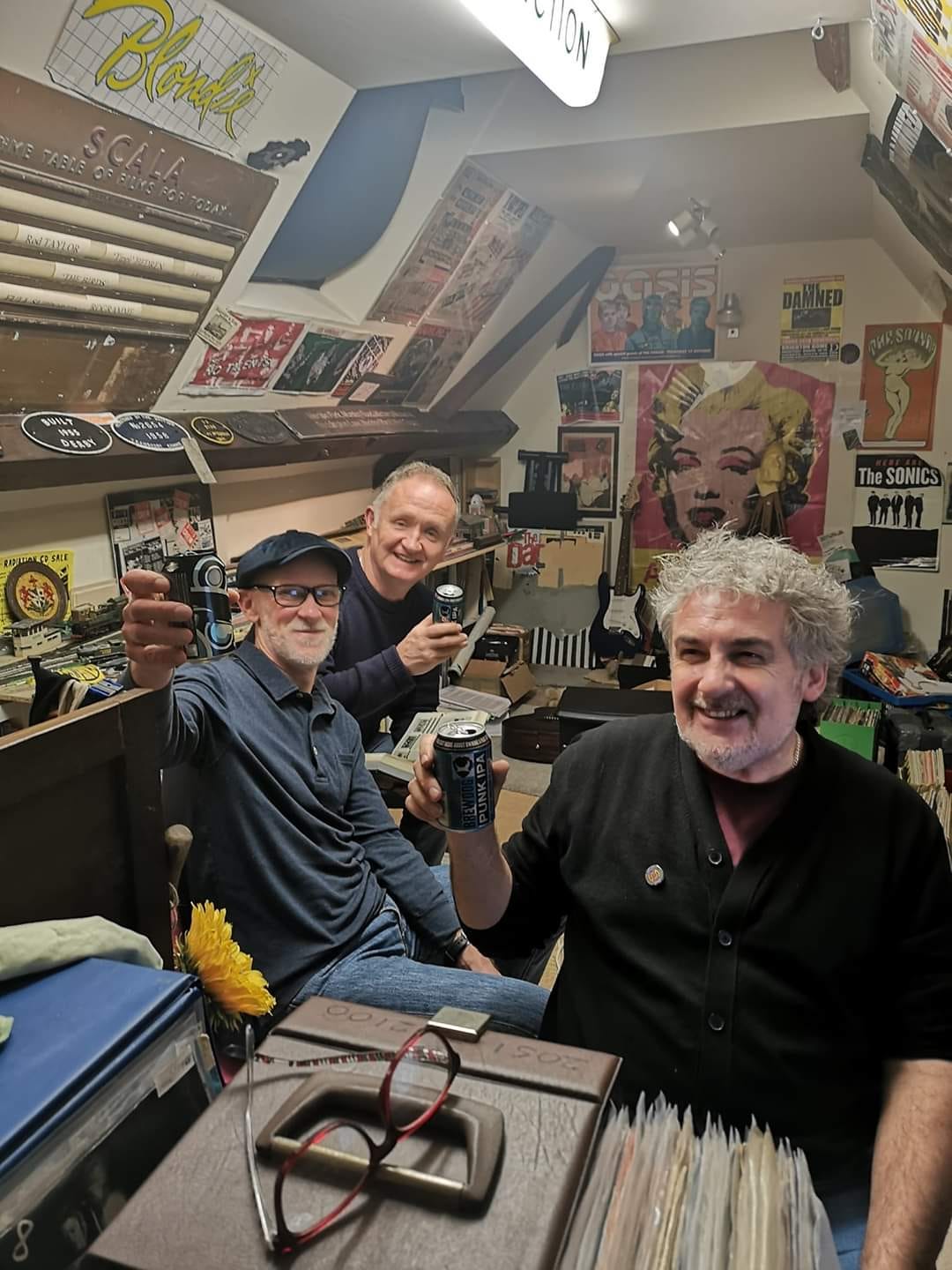
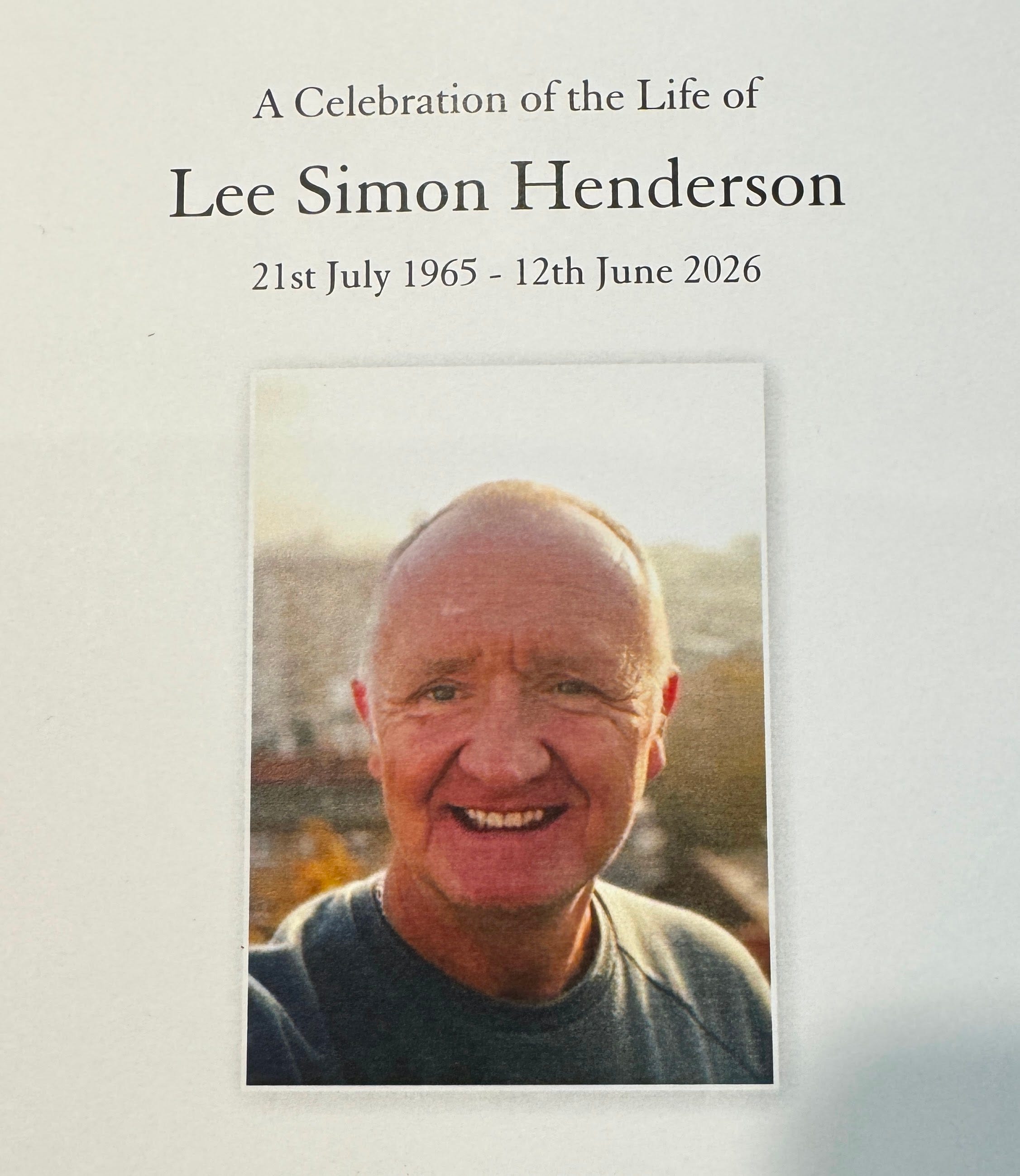
This post is dedicated to the memory of Lee Henderson, one of my closest of closest friends, whose unexpected death at the age of 60 this last month meant that, rather than seeing him in Brighton or London for a drink, perhaps a meal, maybe a gig, but definitely a chat and a good laugh, as we had been texting about only weeks earlier, I attended his funeral in Brighton the same day Nic and I had already put aside for our drive to Devon.
Lee was one of those individuals who loved life, and therefore lived it to the full. We first met when he showed up on the Jamming! football team as the friend of a freelance photographer. Friendships were fast formed – indeed, Lee lived with my mate Tony Page for a short mad period in Thornton Heath – and despite occasional challenges, only grew stronger over the years. Lee traveled, all over the world – he came to stay with me in my ramshackle accommodations in New Jersey and Boston in 1986, when I had just moved to the US, and a solid 30 years later, in 2016, we found ourselves sharing an unexpected beer in Borneo of all places - but he was never happier than when attending the Great Escape festival in Brighton, where he chose to live after the end of his first marriage, because he loved indie music to the max. Right to the end, he’d be sending me music recommendations from the latest young band he’d seen on their way up in some small venue or remote festival field.
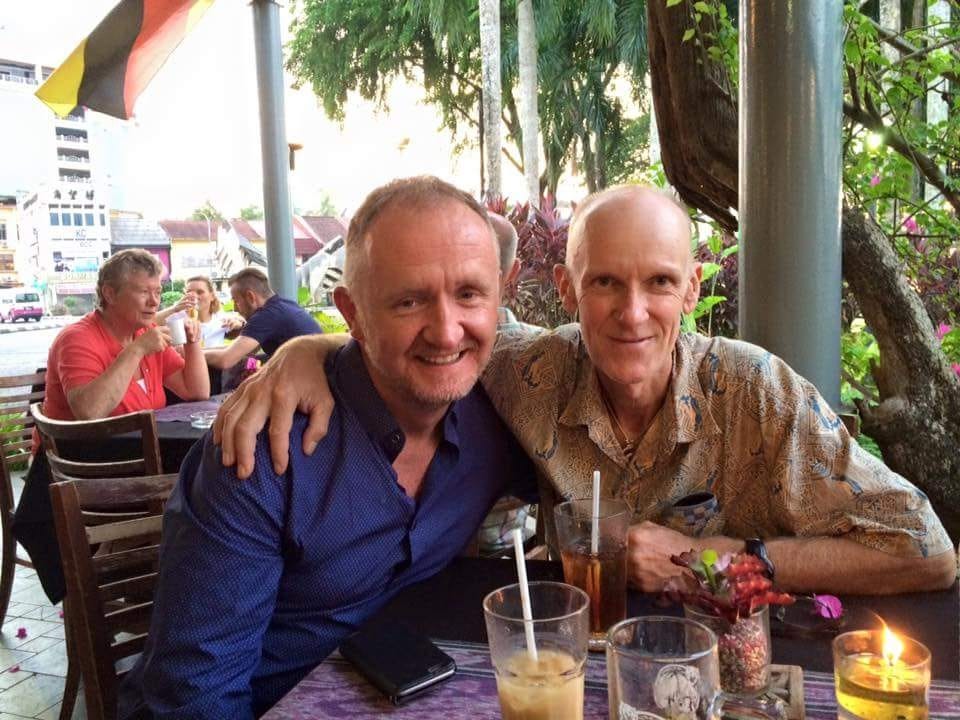
Because he loved life, Lee loved people too, and would chat to anyone, keen to hear their story. Despite or more likely because of this faith in humanity, he was smart enough not to have a social media presence, though he frequently checked in on my Substack. He decided a couple of years back to remarry, and was meant to be on a holiday with his new wife when he was instead taken ill. He passed away two days before their first anniversary.
Lee’s sudden departure shocked me to the core when I woke to the news of it on a Sunday morning in June, and I did what I often do in such circumstances: I ran to/in the hills so no one could see me cry. I’d expected to shed a lot more tears at his funeral last Friday, but Lee’s six-decade physical presence on earth had been so positive, so optimistic, so relentlessly upbeat and life-affirming, that the funeral and subsequent lunchtime pub wake turned into a celebration of a life well lived, rather than a commemoration of a life cut short. As one of his two grown sons, each of whom I had known from birth, even though I had not seen them now for many years, had already described the sudden departure of their loving father, “It wasn’t like something bad happened, as much as that something good stopped.”
As per everyone in our close friendship group – the central friendship group of my life - I will miss Lee, just as I will miss everyone else among that group who passes, hopefully none so soon, in turn. (Unless I go next, of course, in which case I have to hope they will miss me.) Still, Lee left a shining example of how to live a life. An example that will continue to radiate. We all die, but the best of us live on, in spirit for sure, forever.
In his excellent debut novel When I Died for the First Time, Tim Booth has his rock star narrator demand to witness the actual cremation of his mother, rather than just the preceding ceremony, with suitably unpredicted results; given the number of songs that Booth, who doubles as the singer and lyricist for the band James, wrote about his own mother’s latter years and her eventual demise, there was much in this for the armchair psychiatrist reader to ponder.
There is a dark humour here which seems like a natural coping mechanism for many of us; when I had real-time conversations about this while in England, I was often greeted with casual responses such as, “Oh yeah, my mum and dad are still on the mantelpiece.”
A wonderfully detailed and touching read. I once holidayed as a child in Beer, a lovely little village and almost killed myself running down a hill that was too steep for such activity, quickly accelerating to the point I was a human missile, mercifully brought to a halt by an unimpressed thorn bush of some description, which tore my legs to shreds. Happy days! Just as you report I would be up before breakfast and straight out to explore. We only went there because it was my turn again to pick where we went so I stuck to my choice of funny names, as the previous holiday in Looe had been a success. You write so beautifully it brings all this stuff back. Dust flies from the brain.
Thank you for sharing this beautiful remembrance and loving journey of your mother. And your friend. Blessings to you and your brother.