

What I'm Reading This Summer
Books on football songs, punk rock, running into old age, and Buddhism.

I love print. It’s how I started out on my creative journey, it’s what most people know me for. Note that this is not just writing that I am expressing a love for, and not just words that I love, like the words you see in front of you on your screen right now, though all of that is true, but print, the tactile and tangible process of holding something in my hands, of letting those words lead me figuratively and literally from column to column, page to page, story to story, concept to analysis to op-ed to reportage to unexpected ending. Print takes you on a journey in a way that mere words can not.
Confirmation of my love for print comes from the fact that in my recent domestic move, I let a large amount of my physical musical collection “go” and yet I failed miserably to do the same with books. Indeed, while I literally “returned” some cassettes and records to their “rightful” owners while in the UK this last month (some of these cassettes over 45 years old!), I nonetheless came back across the Atlantic, as always, with about half a dozen newly acquired books and yet more by way of magazines. As Sandie Shaw did not quite sing, There’s always something there to entice me.
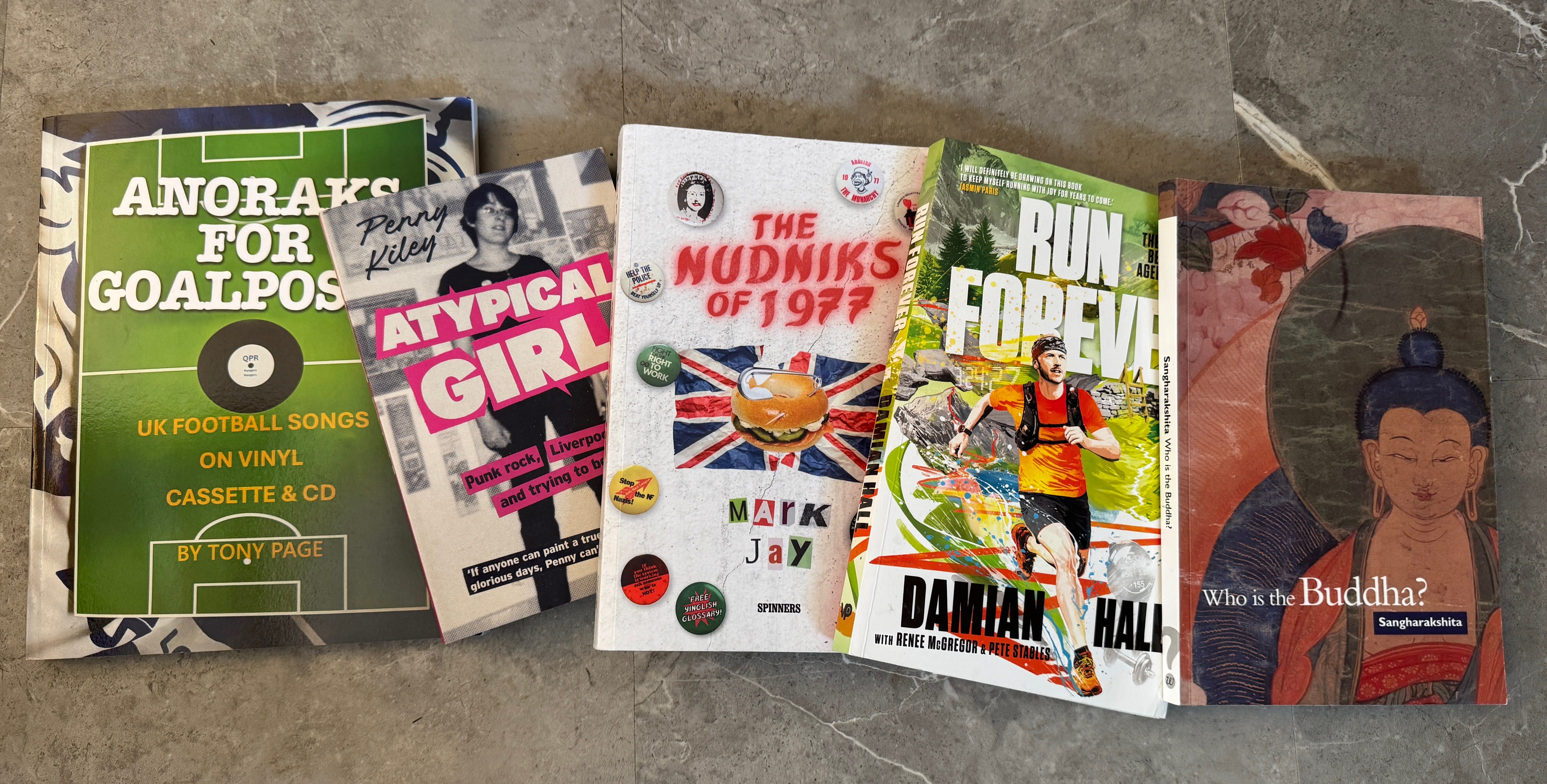
The mags may yet make another post. For now, here are the books I have at least started reading, one of which I have even finished. All of them have an indie sensibility to them, four of them being published accordingly. Four of them are new. And while I should state as a disclaimer, that I know four (again!) of the five authors to varying degrees (albeit that I’ve only met one of them in the flesh in the last 45 years), I can also point out that I know a lot of authors, or at least people who have published books, and if I denied publicity to any of them I’d be doing as big a disservice as I would were I write to glowingly about everyone I know who has published a book. Proximity does not guarantee affinity.
So, let’s kick off, shall we?
Tony Fletcher, Wordsmith posts twice a week, minimum, usually on Thursdays and Sundays. To receive all posts in your Inbox, please subscribe. To keep the page going, please consider a paid subscription at just $6 a month, $60 for the year (less than £5/£50 at current exchange rates.) You get access to all the archives all the time, exclusive interview transcripts, and the monthly Crossed Channels podcast I host with Dan Epstein . You also keep the idea of the written word alive, and in print.
“Anoraks for Goalposts: UK Football Songs On Vinyl Cassette and CD” by Tony Page (Victor)
Gifted to me in its original form just in time to provide a welcome distraction from some of the World Cup’s less savoury capitalist cash-ins, Anoraks for Goalposts, by my Dear Boys band-mate Tony Page, is the third in a series of DIY books, mostly about DIY Records. (The previous were both called Anoraky In The UK.) For while Pagey ensures to reference here those hit football singalongs some of us (Brits) remember from our youth – “Nice One Cyril,” “Blue Is the Colour” and of course, the 1990 Crystal Palace FC rendition of “Glad All Over” – it’s the obscurities that make this book so much fun.
Open up at a random page – let’s try it – and you might find Pagey writing about the hitherto surely-unknown Carluke E.U. Boys Club (and Friends!) who in 1986 pressed up a 7’ single called “Scotland OK.” (They could hardly have called it “Scotland Brilliant,” could they?) A dozen pages further and Pagey’s tracked down a white label of Exeter City F.C. singing “Swing Along With City” from the late 1970s, presumably not referring to that decade’s communal matrimonial parties.
Manchester City are not spared a reminder of the time in the early 1970s they okay’d a funky song called “Me Ball’s Burst” with a pic of a near-topless blonde on the cover. But on the other side of the pc coin, Pagey waded through all 101 songs About Sport by Sportchestra! (Chumbawamba incognito in 1988) to find a lone entry for Barnsley Football Club: the song “All’s Well At Oakwell,” in which Sportchestra! noted that the club in question was leading the way in providing adequate facilities for the disabled. It is, apparently, “a jazzy amalgamation of electric guitar, sax, bass, drums, a fiddle and backing “ahhhs.”” A quick listen – and Sportchestra!’s 101 songs were, of necessity, not on the long side – confirms as much.
Anoraks for Goalposts is as much a fanzine as it is a book. Laid out with love, if not Adobe, and written with the same kind of charismatic flair and disregard for convention (i.e. grammar) as all those super-stars players of the early 1970s, from Stan Bowles to Charlie George and of course, the unrepentant Georgie Boy Best, Anoraks celebrates the minnows, the unknowns, the cruelly – and sometimes appropriately – forgotten. The book has subsequently been picked up for distribution by Victor Publishing which recommended a name change to Football On Record. While I wish he hadn’t gone along with that, it does mean I can give you a website for purchase rather than Pagey’s personal e-mail.

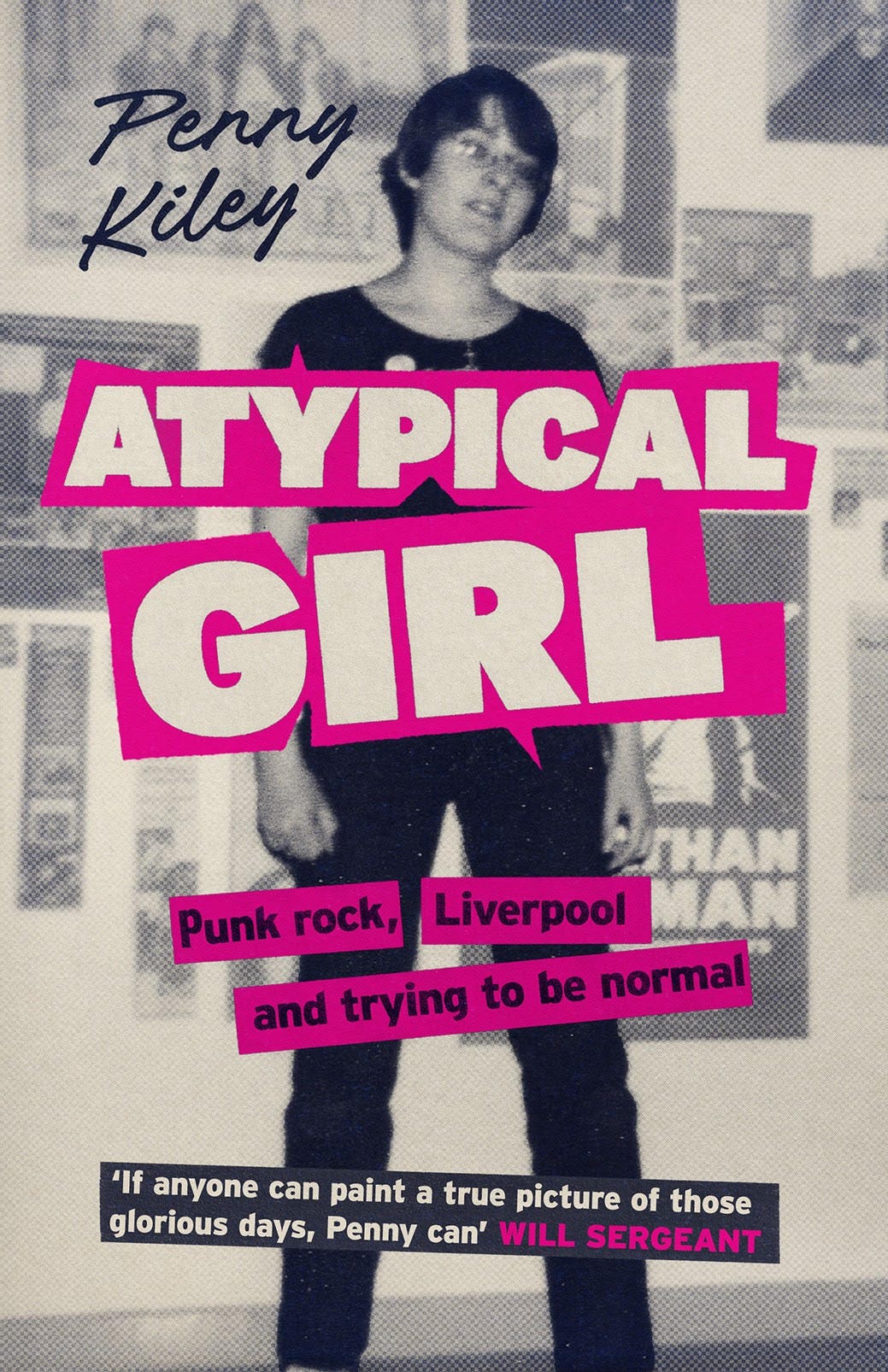
“Atypical Girl: Punk rock, Liverpool and trying to be normal,” by Penny Kiley (Polygon)
For the simple reason that women were largely frozen out of the music scene as anything much more than pin-ups or lead singers until the free-for-all that was punk rock and its fall-out, so it has taken decades for memoirs to land from those who broke the mold. If the excellent recollections by Viv Albertine and Tracey Thorn (whose Bedsit Disco Queen is namechecked in Atypical Girl) helped lead on the musicians’ front, then Penny Kiley’s brisk, wry, chatty and deceptively insightful account of her years on the frontline of the Liverpool scene now catches up – and not before time - from the perspective of the female music journalist.
Kiley did not set out in life to secure that job; except for Cameron Crowe perhaps, few of us do. Rather, she landed in Liverpool for Uni, having migrated from her very middle-class family home in the Home Counties and, as thousands of students were no doubt doing at the exact same moment all over the country, spent her initial months figuring how to fit in. Fortuitously, she was befriended by a local student of considerable character called Peter Wylie, who invited Penny to a new club, Eric’s. She duly attended for the first time in January 1977, and the rest is… herstory.
Kiley, who comes across as both shy and rebellious, was hooked. That meant she was on hand and in the audience as the likes of Echo & The Bunnymen, The Teardrop Explodes, Wah! Heat (featuring that student friend of hers, Peter Wylie), Orchestral Manoeuvres In The Dark and others revitalized Liverpool’s musical reputation beyond that of a faded Merseybeat and a Beatles who moved to London at the first opportunity. But Kiley also documented that pulsating period, quickly landing freelance work at Melody Maker, where for many years her enthusiastic dispatches were seen as the authoritative inside scoop. (Later she wrote for Smash Hits, which in describing it as “the zeitgeistly chronicler of the new pop world” suggests she still could!)
Somewhere round the 100-page mark Kiley shows herself especially capable of the wide angle as well as the zoom-in. She observes of the 1980s that they were many decades in one, all running parallel to each other, The Smiths at the same time as Kajagoogoo. She notes, intriguingly, that she chronicles her own life not by bands or relationships or living quarters, but by venues, a methodology I’ve never thought of before. She claims, with evidence, that “gay men saved pop music in the 1980s.” But most tellingly, she writes that “We made the best and most interesting post-punk pop in the country,” and it is now evident that along the path of her atypical journey, Kiley came to consider himself a Liverpudlian every bit as much as I once felt like a New Yorker.
In more recent years, no longer living in the ‘Pool, Kiley has taken to documenting and re-publishing her 1970s and 80s journalism on her Substack, in which capacity we’ve become pen pals (alright, e-mail pals), something I don’t remember being the case back when our paths must have criss-crossed on a regular basis. On September 13 of this year, in Liverpool itself – at the British Music Experience no less – we will finally get to meet, when Penny will be hosting a conversation with me about my own new memoir. By that point in time, I vow to have finished Atypical Girl, but in the meantime, on one subject I know we agree. It’s one that she tackles in a short chapter about the “Knowledge” one must acquire, without a roadmap, let alone a taxi driver’s gazetteer, to become a respected music journalist.
“You have to take seriously the arguments about who was the greatest rock drummer ever. (Keith Moon, obviously.)”
“The Nudniks of 1977” by Mark Jay (SKUM)
Under normal circumstances, this vital meta-novel about the early punk days from someone who lived them, has the proven literary chops to write about them, and a specifically unusual background to merit his telling all the more interesting, would receive a dedicated post of its own. But I did that with Mark Jay’s recent collection of Bowie-tinged poems, Five Years, and had him on The Fanzine Podcast before that, and given that he and I have re-established contact after but a brief friendship 45 years ago, only to discover that we appear to be 21st Century soul brothers, I wouldn’t want our mutual endorsements to appear too damned incestuous.
So, here’s a reminder of the author’s cred(entails). Mark Jay was just 14 when he found himself invited into the core of the London punk scene, befriending and befriended by both the Sex Pistols and The Clash, and launching his fanzine SKUM as part of that punk process by which everyone on the scene contributed something to the scene. (The reformed Sex Pistols are currently featuring the debut SKUM cover, of a pre-Pistols Sid Vicious, as a backdrop on tour.) That means he was just 15 when he attended the Pistols’ Silver Jubilee boat trip/concert on June 7, 1977, where he was arrested and duly spent the night in jail. Later that year Malcolm McLaren and Vivienne Westwood, having seen Mark’s cartoon of the Sex Pistols v. Bill Grundy TV fiasco – “the night the air turned blue” as Jay references it in Nudniks - commissioned a ‘Story So Far’ from him that became the insert to the Never Mind The Bollocks album.
By the end of that year, still just 15, Mark Jay scrapped SKUM to start a Beat Poetry zine instead. A little over a year later, having joined Apocalypse via a classified ad and spent about six weeks trying to teach my schoolboy band how to get properly funky and dubbed-up before giving up on us, he decided to follow his beat(ing) heart to the land of his poetic heroes, and spent years subsequently living in the USA, Morocco, and Russia. Throughout, Jay never stopped writing, be it poetry or prose, be his subject matter political or personal.
All this renders Jay the perfect person to pen a semi-autobiographical novel of those times. But his ace, that which sets The Nudniks of 1977 apart from any competition that may deign to raise its head, especially next year when the Two Sevens celebrate their own Silver Anniversary, is revealed in its title: his Orthodox Jewish background. Mark Jay experienced punk’s early days from the inside while also attending the Jewish Free School in Camden Town; when not voluntarily pogoing at the Roxy, he was engaged in enforced davening at home. This doubly confused, dual-life teenage existence rewards the reader – especially the Goy reader like me – with a whole different appreciation of the sheer cojones it took to be an early adopter on the punk rock scene. (Even if those cojones had yet to drop.)
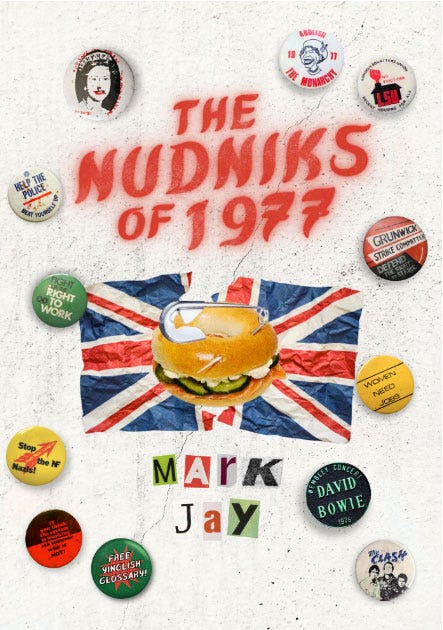
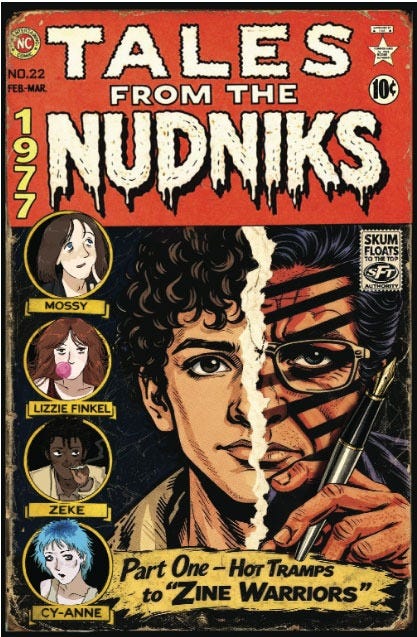
To the extent that The Nudniks is taken to be autobiographical (its narrator, Herbert Hazard, also attends a JFS-style school, also starts a zine called, also attends the Pistols boat party where he also gets arrested), then the real Mark Jay did not venture alone; the novel is titled in the plural, after all. (A Nudnik, according to the Yiddish-English glossary at the back of the book, is a term for “someone who won’t take it lying down,” i.e. a “proper punk.”) In the literary retelling, Herbie is accompanied by Mossy, a particularly streetwise kid who descends into the darker cliches of drug-addled punk; and Zeke, the rare black kid on the scene, whose mum is part of the Grunwick Strike Committee and who rapidly leans into punk’s rebel music sibling, Rastafarianism. Grunwick’s importance to the times, I now realise, as a strike led not just by women, but women of colour, has been relegated to a footnote in a 1977 that has more salacious headlines; it’s good that Jay brings it back to the fore.
There’s also the seductive Lizzie Finkel, an archetypal Jewish Princess who sees in Punk an avenue to experience an energy and unpredictability she can’t ever expect in her gilt-edged North London mansion. Additionally, Herbie also has a staunchly leftist, borderline Communist for a ‘Grampy,’ and a teenager female member of a Red Army Faction sleeper cell for a pogo and zine partner.
Put like this, it all sounds gloriously absurd – a wishful rewrite of a more mundane origin story, perhaps. But Jay is far too skilled for that, which is why I call it a meta-novel in my opening line. The Nudniks of 1977 may mainly read like it’s written from within the moment, but Hazard’s teen story is in fact – or in this fictional reworking of fact - being typed by an adult Herbert Hazard decades down the line, back at the old house, the one that was once full of matzo balls and menorahs, but which is now a sterile Air BnB. There, in his childhood bedroom, surrounded by boxes of youthful mementos his now deceased mother had kept without his knowledge, and in front of his faithful old Olivetti typewriter, he sets out to complete the gaps in his younger self’s attempts at real-time documentation. Whether this is truly how The Nudniks of 1977 came about, the author doesn’t tell. Because good writers don’t do that; they show, instead.
Similarly, when, towards the end of this lengthy literary journey that is forever a whirlwind, that narrator writes of “that year-and-a-bit of glorious creative turmoil punk had borne,” that…
“For a Nudnik from nowhere I had met some of the most extraordinary people I would ever encounter. And my life might have irreversibly changed if the world had changed too. But it hadn’t.”
…I am tempted to ask whether this is the perspective of the teenage protagonist, his adult reflectionist, or of the actual author, the now 60-something Mark Jay. But to do so would be to miss the point. By layering fact onto fiction (and fiction onto fact) the way some of us used to layer an A4 sheet of type on top of an A4 sheet of halftones back at Better Badges when laying out our fanzines, sometimes leaving our readers to work their senses overtime to discern what we were depicting, Jay has created a work of art. And art exists to challenge us at that thin line where reality meets illusion.
Accordingly, The Nudniks of 1977 is also available as a serialized graphic novel. Given everything else you have just read, why would it not be?
(Both editions are available from https://markjay.tv/skumpublications.html )
”Run Forever: The Secrets to Becoming an Ageless Athlete” by Damian Hall (Vertebrate)
I mail-ordered this book while in the UK for at least three reasons:
1) Hall’s previous book, We Can’t Run Away From This, about running’s often negative impact on the environment, was an eye-opener, and after having him on my old One Step Beyond podcast to talk about it, I keep an eye on his achievements both on and off the trails;
2) I recently sold the idea of an article called “Slower, but Stronger” for the online magazine Oldster and I figured there’d be good source material here to back up my own pet theory about that headline (as there is); and
3) I’m the core demographic for the book. Indeed, on the morning that this review is being published on my Substack, I’ll be off tackling the Escarpment Trail Run (30k of the Catskills Mountains, 5-6000ft each way of highly technical elevation) for the 16th time, knowing that the ageing, slowing process means that I will never be able to match the sub-4hrs I achieved in 2017, but that, especially given my ever-improving fitness and stamina, I don’t see slowing down as any reason to stop. To the contrary, I want to run for ever.
Hall has good news for me, especially on page 25 where a paragraph about the mechanics of cardiovascular exercise and its benefits way beyond the arteries and heart concludes with this bold-typed sentence: We joggers can slash our risk of cardiovascular death - the world’s biggest killer – by 45-70%. It’s just one of many stats that should encourage the most somnambulistic amongst us to engage in some aerobic exercise.
Hall also has bad news, which he decides to put first. It’s nothing one doesn’t instinctively surmise as one ages, but the details nonetheless make for somewhat depressing reading. “Muscles can wave their little white flags as early as twenty-five,” he warns us, noting that muscle power decreases as rapidly as 2-4% per year, which is why track events are essentially a young person’s game.
There’s more. Much more. “From around thirty the hearts peak capacity to pump blood decreases by … 5-10% per decade.” Ditto our VO2 max, meaning “a 70-year-old has lost about 25% of their aerobic horsepower compared to their forty-year-old self.”
Hall is big on facts. At times, this book reads like a student summary of peer-reviewed studies, although his highly chatty, breaking-the-fourth-wall style of writing is as far from academic as one can imagine. It’s not just this informal approach that makes him a good reading companion; it’s that Hall walks it like he talks it, or rather runs it like he writes it. Hall has, at various times since turning 40 – the age at which, ironically, British runners are marked V for Veteran – set the record for fastest times on Britain’s Pennine Way, South West Coast Path, the 185-mile Northern Traverse and the 268-mile Spine Race. Even though he set about this book because he felt himself slowing down by age 50, he is living proof that as we grow older, we also go longer, and as he explains, stronger.
Hall’s credentials no doubt helped garner contributions from other ‘veteran’ runners whose names are familiar to those who know their Western States from their Tor des Géants, such as Nicky Spinks and Tommy Hughes. The book also cites dietician Renee McGregor and coach Pete Stables as co-writers, the former contributing an important section on how ageing affects female runners, especially around (peri)menopause; one would expect nothing less from Hall who, as well as being a strident environmentalist and apologetic vegan, is an ardent supporter of all- and non-gender equality.
Run Forever won’t win any awards for great writing, even by the generally low standards of the nonetheless lucrative self-help category. That doesn’t stop it being a useful addition to an ever-growing canon of positive age-related advice, and there’s more than enough in Run Forever to keep me going strong, more convinced than ever that I’m on pace, and on course to cross the finish line with a smile on my face. Here’s hoping that on today’s Escarpment Run, that proves literal as well as literary.

“Who is the Buddha?” by Sangharkshita (Windhorse)
Those who know me well enough or have read Wordsmith acutely enough won’t be surprised to learn that on this latest, solo trip to London, I decided to look up Buddhist centres close to my Islington accommodation to help me maintain my practice. I ended up visiting the North London Buddhist Centre on Holloway Road a couple of times; it was a highly pleasant experience and I especially enjoyed the talk on the Wheel of Life and our subsequent enforced group chats about it. Still, as the author of this book that I purchased at the Centre notes, “There are a lot of schools in Buddhism (and they are ‘schools’ rather than ‘sects’)” and therefore “one has to be careful when picking up a book about Buddhism, or listening to someone talk about Buddhism, that one isn’t just getting the version of Buddhism put forward by one particular school.”
It is too early in my reading of Sangharkshita’s Who Is The Buddha? to tell you whether this book falls into that particular “trap,” but I know enough now to know that its author was what we might call a thoroughly interesting chap. He was born Dennis Lingwood in Tooting, South London, in 1925, and somehow found his spiritual path in Buddhism while growing up in an almost uniformly Christian society. Subsequently stationed to South Asia during World War II, he chose to hand in his rifle and to formally desert the British Army at the cessation of hostilities, taking a novice Bengali monk with him to wander India as ascetics.
After Partition, Lingwood was ordained as a novice monk himself, given the name of Sangharkshita (“protected by the spiritual community”), and in 1950 he moved to the West Bengal outpost city of Kalimpong, a place I spent a week back in 2016 and would happily return to. Lingwood - Sangharkshita – stayed there for 14 years. During that time he formed a Buddhist centre, launched a Buddhist magazine, and became a renowned teacher. After moving back to England, he founded the Friends of the Western Buddhist Order in 1967, which is now known as the Triratna Buddhist Community, of which the North London Buddhist Centre is a prominent base.
Sangharkshita’s remaining years were not without all-too-familiar controversies of, in his case, same-sex sexual relationships with younger students, some allegedly non-consensual. Power, as we know, corrupts, and Buddhists are not exempt from that corruption. Nonetheless, he was simultaneously regarded as a pioneer of a non-traditional, non-heteronormative Eurocentric Buddhism, and his writings and teachings filled dozens of books, many of which can be found at the North London Buddhist Centre. While part of me wishes I had picked up the biography of his life (he died in 2018) I opted for the one that seeks to answer a seemingly simple question, “Who is the Buddha?,” knowing full well that an easy answer has eluded scholars and students for four and a half Millenia.
By using the present tense, Sangharkshita could have used the past tense (Who was the Buddha?) or rephrased the question more broadly (What is Buddhism?) and had an easier time of it. But, from what I can ascertain so far, the attraction of the title as written is the confirmation, central to Buddhism, that we are all born as Buddhas, complete in every way (the diametric opposite to Catholicism, which has us born laden with guilt) and that our Buddha nature is merely waiting to be re-awakened within us. Embracing the theory of Evolution – and thereby denying every “other” major religion its claim to divinity – Sangharkshita writes (or perhaps “taught,” if the opening chapter ‘The Evolution of a Buddha’ was drawn from a talk rather than an essay):
“Just as the scientific concept of evolution involves a progression towards new biological organisms though periods of time that are practically unimaginable, so, according to Buddhism, our own lives that their place in a context of literally unimaginable temporal duration, on which, however, they are of literally cosmic importance.”
So far, so typically complex. And provocative. I look forward to reading on.

What are YOU reading this summer in book form?
Thanks Tony! Looking forward to meeting you in real life.
The first suggestion here really caught my eye. I never thought about there being a recording scene for football songs, but of course there must be one.
As a distant lover of a UK football team, and having not grown up in England, the songs I hear on match day broadcasts (or better, fan-recorded YouTube clips) are full-tilt fascinating, if not always for lyrical wit, for the mystery of their origins. Social media surely helps ultras get their melodic act together before they hit the grounds. But what's the genesis of these take-off versions? How do the fans decide what works for a song, and how many are now resorting to AI to "write" these things? And how many do that, then try to hide it? Imagine how much, say, Rangers and Celtic fans would loathe either opposite even more* when one discovers the other uses a bot to up their teams or harass their enemy?
And why is this not a North American thing now, at least outside of second-tier soccer? We rip off every other damn thing on the list, why not this? Could it be because we're allowed to guzzle our beers in our seats instead of just the concourses, and therefore our throats are already busy?
Some MLS fan bases (NY/NJ, Orlando, Portland) seem to "bring the song," but I'm not sure it's the majority. In next-level USL Championship, however, you hear lots of songs and chants. But it seems to tail off sharply as you go down to USL-1, where the supporter groups get smaller. We have songs and chants in college hockey, traditionally, but they don't vary by opponent. General-purpose insults seem to be the standard there. But it's never spread to the NHL or the drunken bacchanals of Saturday afternoon SEC or Big 10 games. 100-year-old Alma Mater songs, sure, but thousands of voices questioning the intelligence and grooming of the opposing fans to the tune of some Shaboozey hit? Not as much.
And I'm not arguing for that. Chants and vulgar renditions of "Wonderwall," or whatever, seem to me a fixture of the British game that separates it from the global pack, as much a UK tradition as trading out the Prime Minister every third Thursday. So, good on you, mates, and let us know when Cherry Red compiles a 12-disc monster box set of football cries that makes every footy fan swell with pride and search for new words that rhyme with "prick"?
Big thanks.
*If that's possible.